CASE STUDY · TORY
LIVE · ON-DEMANDMobile services,on-demand.
Open the app. Drop a pin. A mobile unit is on its way.
Tory brings mobile services straight to you — to the middle of the city, to a park, to an open-air event, or anywhere a fixed solution simply doesn't exist. Instead of hunting for the nearest public option or holding out until you get home, you open an app, choose a location, and a mobile unit is dispatched.
We built the product from the ground up — a client app, a driver app, and a server-side platform that ties the two together in real time.
- apps
- 2
- client · driver
- matching
- AUTO
- Dispatch engine
- tracking
- REAL-TIME
- Live ETA on map
- payment
- E2E
- Secure, in-app
01 / What we built
Three products. One system.
We built the entire stack from scratch — two front-line surfaces, and a server that keeps them in sync in real time.
02 / Client app
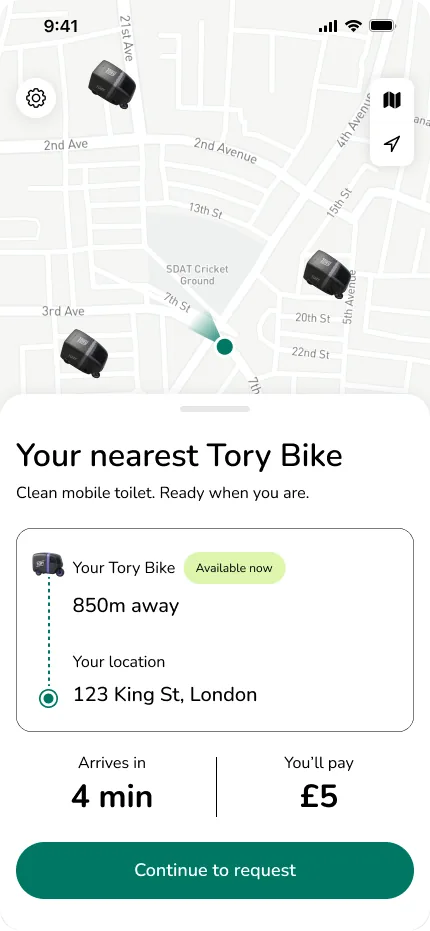
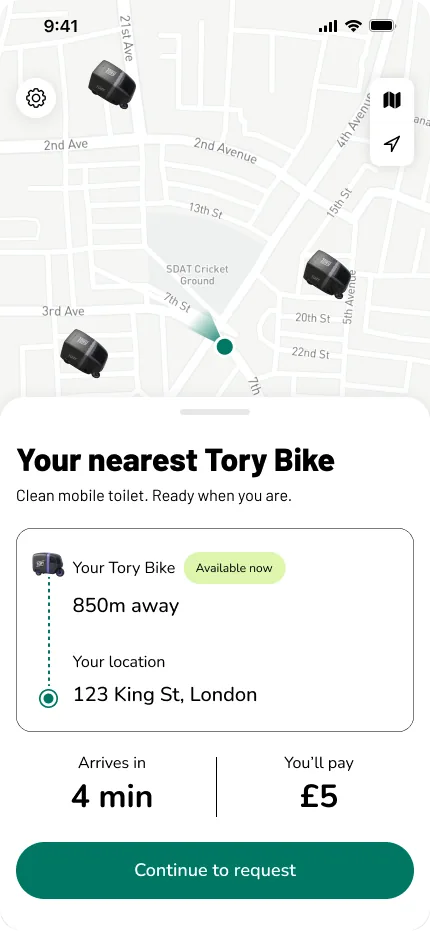
Clean interface. Three actions.
- Drop a pin on the map and confirm.
- Watch the driver approach — the same experience as a ride-hailing app.
- Pay inside the app. No calls, no chat threads, no figuring out who owns what.
03 / Driver app
A field-grade cockpit for the driver.
- New orders arrive in real time with location details.
- Built-in navigation — no jumping between apps.
- Status buttons that update the customer automatically: en route · arrived · done.
- No phone calls, no text messages — everything stays inside the system.
04 / Auto-dispatch
A dispatch engine that matches by location.
The system reads the customer's location and the available drivers nearby, then routes every order to the driver who'll arrive fastest. ETAs stay short during rush hours and large events alike.
- Live geolocation
- Driver availability
- ETA optimization
- Manual override
05 / Real-time tracking
The customer sees it. Ops controls it.
The same real-time backbone — two very different surfaces. For the customer: a clean ETA on the map. For ops: the entire fleet on a board, with the power to step in.
06 / In-app payment
Secure end-to-end payment.
No cash in the field. No credit cards handed to drivers. No invoices to chase. The order closes automatically when the service is complete, and revenue syncs straight to the dashboard.
07 / Technology
The stack behind the scenes
A modern stack chosen for the job — fast to build, stable in production, alive in real time.
Mobile
- React Native
- Expo
- TypeScript
Backend
- Node.js
- NestJS
- Socket.IO
Database
- PostgreSQL
- PostGIS
- Redis
Maps & Routing
- Google Maps
- Mapbox
- Geocoding
Payments
- Stripe
- Tranzilla
Cloud
- AWS
- CloudFront
- S3
Observability
- Sentry
- Datadog
- Logflare
Delivery
- EAS
- CI/CD
- OTA Updates
08 / Decisions and constraints
The decisions behind the structure
Everything described above is the result of a few product decisions made early. These are the decisions, and the constraint each one answered.
09 / What was delivered
What was delivered — and where the responsibility line runs
A good case study also says what wasn't included. This is what Onezero Labs built and delivered in this project, with no unpublished metrics.
| Component | What was delivered | Note |
|---|---|---|
| Client app | iOS and Android: map, location pin, order confirmation, live driver tracking, in-app payment | React Native · Expo · TypeScript |
| Driver app | Real-time order intake, built-in navigation, status buttons that update the customer | React Native · Expo · TypeScript |
| Server platform | Location-based dispatch engine, real-time sockets, billing, ops dashboard with live intervention | Node.js · NestJS · Socket.IO · PostgreSQL/PostGIS · Redis |
| Payments | In-app payment and automatic order close-out when the service ends | Stripe · Tranzilla |
| Infrastructure and operations | Cloud, distribution and OTA updates, error and performance monitoring | AWS · EAS · Sentry · Datadog |
| Out of scope | This page describes the software that was built. Operating the service itself — drivers, mobile units and customer support — is not part of the project described, and the service's operating numbers are not published here. | — |
Planning a similar on-demand product?
This structure — a customer app, a service-side app and a real-time backend — recurs in most products of this kind. What changes is the scope: how many roles, which integrations, and what must be in the first version.
Got a similar idea?
From the idea to an app that actually moves.
We built Tory from zero — two apps, a real-time backend, end-to-end payments. If you have an on-demand idea waiting to ship, let's talk.
On-demand. In the field. In real time.
Related services and reading
- ServiceMobile app development for iOS and AndroidThe service behind Tory: Native, Cross-Platform, Realtime architecture and field-grade fleet support.
- ComparisonReact Native vs Flutter — which to pick in 2026Cross-platform framework comparison: performance, native module access, maintenance cost, talent pool, and OS updates. Recommendation by product type.
- GuideReact Native vs Flutter in 2026 — what's actually right for startups?Long read: performance, hiring, OTA, scale, web synergy and time-to-market. The pragmatic call for most 2026 startups.